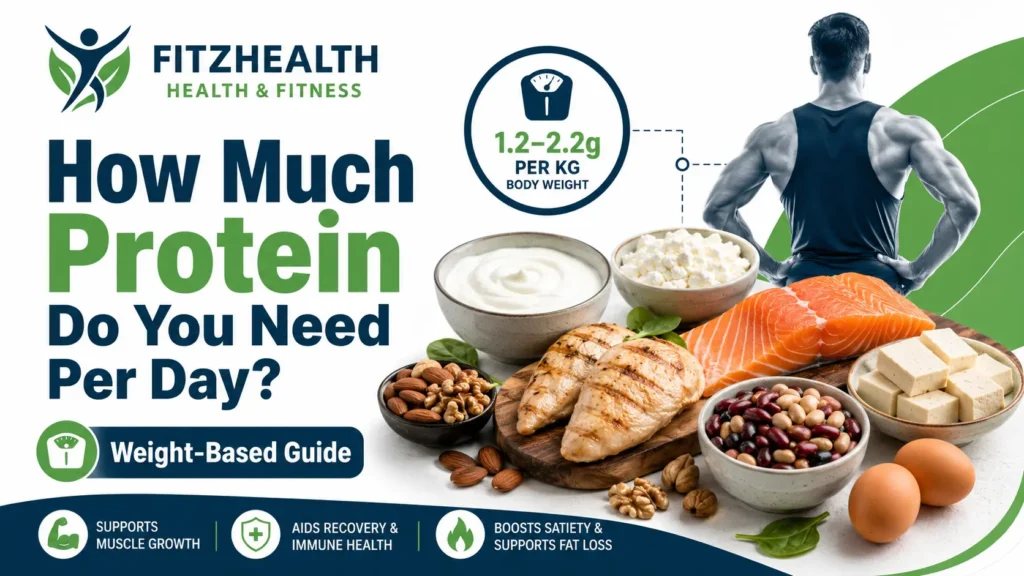
Protein recommendations can become confusing very quickly.
One person may tell you that everyone needs 100 grams per day. A fitness trainer may recommend two grams per day for every kilogram of body weight. Meanwhile, food labels often use 50 grams as the standard daily value.
So, how much protein do you actually need per day?
The answer depends on your body weight, age, activity level, exercise routine, pregnancy status and overall health.
For most healthy adults with minimal physical activity, the standard recommendation is approximately:
0.8 grams per kilogram of body weight per day.
However, physically active people, older adults, athletes and pregnant or breastfeeding women may need more.
Quick Answer: Daily Protein Requirement
For a generally healthy adult, use the following formula:
Body weight in kilograms × 0.8 = grams of protein needed per day
For example:
-
- A 50 kg adult needs approximately 40 grams per day.
-
- A 60 kg adult needs approximately 48 grams per day.
-
- A 70 kg adult needs approximately 56 grams per day.
-
- An 80 kg adult needs approximately 64 grams per day.
This recommendation is a general starting point. Your actual requirement may be different depending on your lifestyle and health.
What Is Protein?
It is one of the major nutrients required by the human body.
It is made from smaller compounds called amino acids. During digestion, dietary protein is broken down into amino acids, which the body uses to build and repair tissues.
Nine amino acids are considered essential because the body cannot produce enough of them on its own. They must be obtained through food.
It is involved in several important functions, including:
-
- Building and repairing muscles
-
- Maintaining bones and body tissues
-
- Producing enzymes
-
- Forming certain hormones
-
- Supporting growth and development
-
- Transporting nutrients through the body
-
- Supporting normal immune function
Every cell in the human body contains protein.
How to Calculate Your Daily Protein Requirement
The easiest way to calculate your baseline protein requirement is:
Body weight in kilograms × 0.8
Example for a 70 kg Person
70 × 0.8 = 56
A generally healthy and minimally active person weighing 70 kg would therefore need approximately 56 grams per day.
How to Convert Pounds into Kilograms
Divide your weight in pounds by 2.2.
For example:
154 pounds ÷ 2.2 = 70 kilograms
Now calculate the requirement:
70 × 0.8 = 56 grams per day
This formula is intended as a general reference for healthy adults. It does not account for intensive training, pregnancy, older age, recovery from illness or medical conditions.
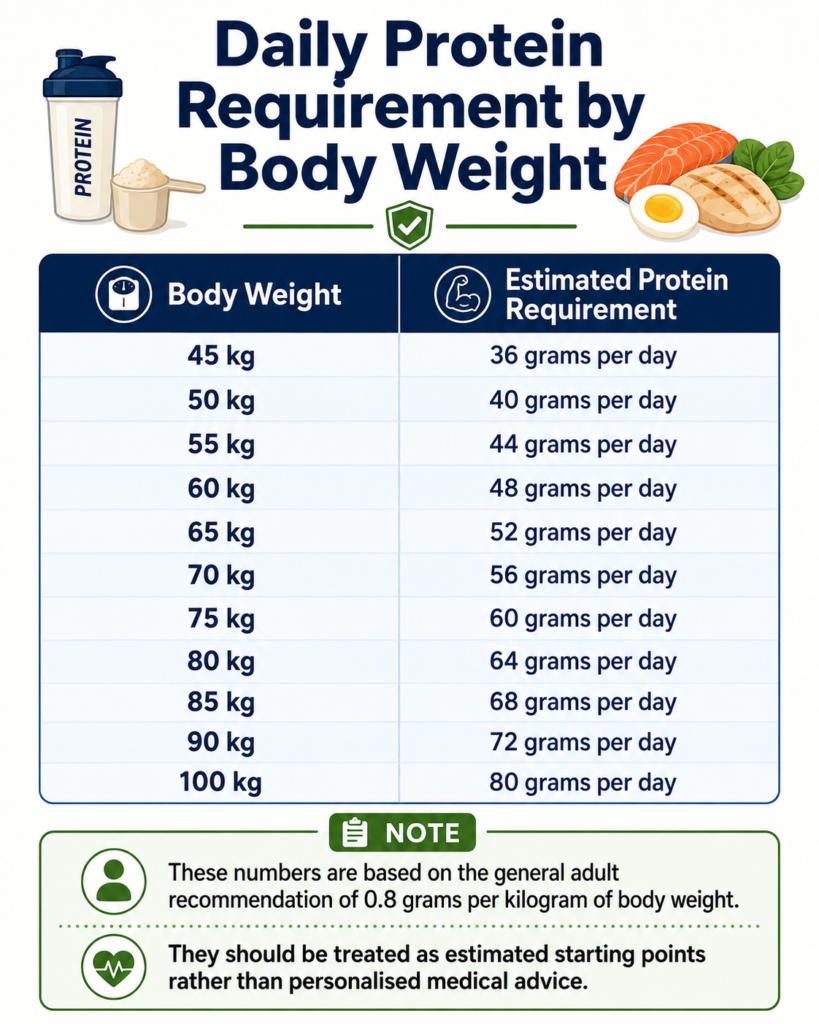
Daily Requirement by Body Weight
| Body Weight | Estimated Protein Requirement |
| 45 kg | 36 grams per day |
| 50 kg | 40 grams per day |
| 55 kg | 44 grams per day |
| 60 kg | 48 grams per day |
| 65 kg | 52 grams per day |
| 70 kg | 56 grams per day |
| 75 kg | 60 grams per day |
| 80 kg | 64 grams per day |
| 85 kg | 68 grams per day |
| 90 kg | 72 grams per day |
| 100 kg | 80 grams per day |
These numbers are based on the general adult recommendation of 0.8 grams per kilogram of body weight.
They should be treated as estimated starting points rather than personalised medical advice.
Protein as a Percentage of Daily Calories
Protein recommendations may also be expressed as a percentage of total calorie intake.
For adults, approximately 10% to 35% of daily calories may come from protein.
For someone eating 2,000 calories per day:
-
- 10% of calories from protein equals 200 calories.
-
- 35% of calories from protein equals 700 calories.
-
- One gram provides approximately four calories.
This would equal approximately 50 to 175 grams per day.
However, this range is very broad. Calculating protein according to body weight is generally more practical for estimating an individual requirement.
Why Does Protein Requirement Vary?
Two people with the same body weight may not need the same amount of protein.
A person who spends most of the day sitting will not have the same recovery requirements as someone who performs regular strength training.
It needs may be influenced by:
-
- Body weight
-
- Age
-
- Activity level
-
- Exercise intensity
-
- Resistance training
-
- Endurance training
-
- Total calorie intake
-
- Pregnancy
-
- Breastfeeding
-
- Illness or injury
-
- Recovery from surgery
-
- Kidney function
-
- Other medical conditions
This is why one protein target should not be applied to everyone.
How Much Protein Do Active People and Athletes Need?
People who exercise regularly may require more protein than people with a sedentary lifestyle.
Exercise increases the need for muscle repair, recovery and physical adaptation.
For most exercising individuals, a daily protein intake of approximately:
1.4 to 2.0 grams per kilogram of body weight
may be sufficient.
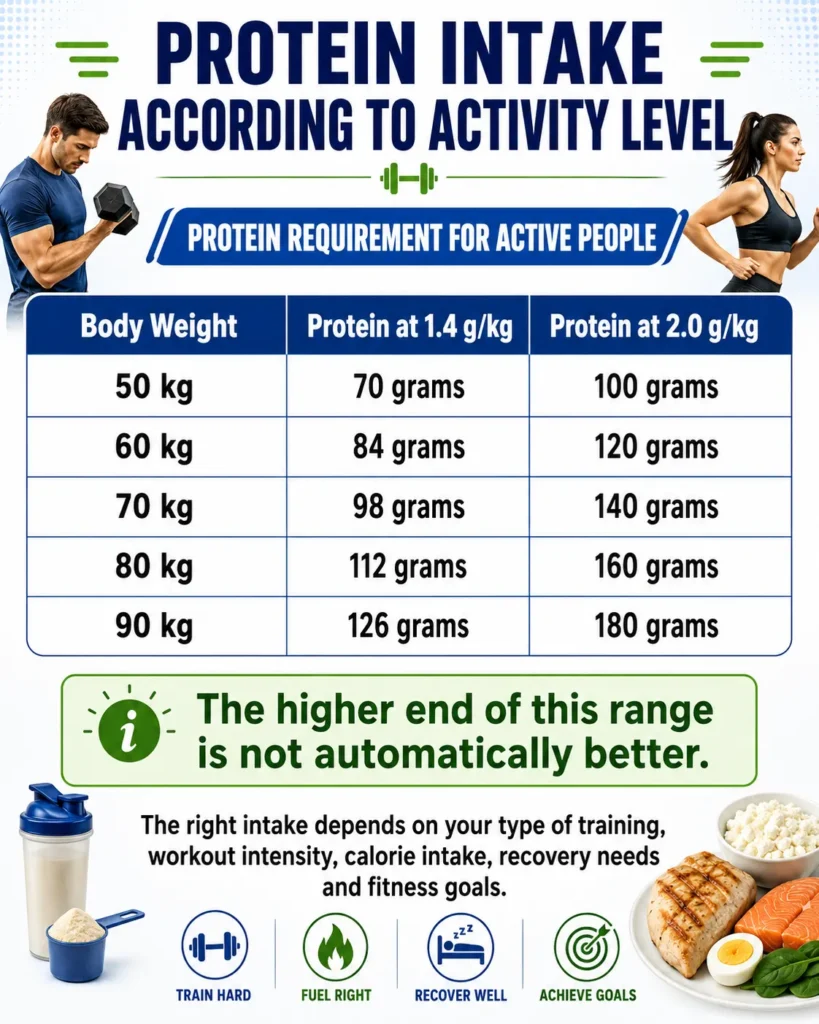
Protein Requirement for Active People
| Body Weight | Protein at 1.4 g/kg | Protein at 2.0 g/kg |
| 50 kg | 70 grams | 100 grams |
| 60 kg | 84 grams | 120 grams |
| 70 kg | 98 grams | 140 grams |
| 80 kg | 112 grams | 160 grams |
| 90 kg | 126 grams | 180 grams |
The higher end of this range is not automatically better.
The right intake depends on your type of training, workout intensity, calorie intake, recovery needs and fitness goals.
How Much Protein Do You Need to Build Muscle?
Resistance exercise provides the stimulus for muscle growth. Dietary protein supplies the amino acids required for muscle repair and development.
For most people involved in regular resistance training, approximately 1.4 to 2.0 grams per kilogram of body weight per day generally covers muscle-building needs.
For example, a 70 kg person may require approximately 98 to 140 grams per day, depending on training intensity and overall diet.
Protein intake alone cannot build muscle.
A muscle-building routine should also include:
-
- Consistent resistance training
-
- Adequate calorie intake
-
- Sufficient daily protein
-
- Proper protein distribution
-
- Rest and recovery
Drinking a protein shake while your dumbbells collect dust is not quite the same as resistance training.
Do Older Adults Need More Protein?
Ageing is commonly associated with a gradual reduction in muscle mass and strength.
Older adults may also have a weaker muscle-building response to small servings of protein compared with younger adults.
Adults aged 50 and above may benefit from approximately:
1.0 to 1.2 grams per kilogram of body weight per day
For a person weighing 70 kg, this equals:
-
- 70 grams per day at 1.0 g/kg
-
- 84 grams per day at 1.2 g/kg
Older adults who perform regular strength training or are recovering from an illness may require more personalised recommendations.
Protein intake should ideally be combined with resistance exercise because muscles need both building material and a reason to adapt.
Protein Needs During Pregnancy
The requirements increase during pregnancy because it supports maternal tissue changes and fetal growth.
European reference recommendations suggest approximately:
-
- 1 additional gram per day during the first trimester
-
- 9 additional grams per day during the second trimester
-
- 28 additional grams per day during the third trimester
The requirements may vary depending on body weight, dietary intake, health conditions and whether the pregnancy involves twins or multiple babies.
Pregnant women should discuss individual dietary requirements with their obstetrician or qualified dietitian.
Protein Needs During Breastfeeding
Protein requirements also remain elevated during breastfeeding.
General reference recommendations suggest approximately:
-
- 19 additional grams per day during the first six months
-
- 13 additional grams per day after the first six months
These are population-level reference values and may not be suitable for every individual.
Protein Requirements for Children and Teenagers
Children and teenagers should not automatically use the standard adult protein formula.
Their requirements vary according to age, growth stage, body weight and overall calorie intake.
It needs for infants, children and teenagers may range from approximately 0.83 to 1.31 grams per kilogram per day, depending on age.
Parents should avoid putting children on restrictive or extremely high-protein diets without professional guidance.
How Much Protein Should You Eat at Each Meal?
Your total daily intake is important, but distributing protein across meals may make the target easier to achieve.
It may also support muscle protein synthesis more effectively than consuming most of the day’s protein in one meal.
For active people, approximately 20 to 40 grams per meal may be a practical target.
For someone aiming for 90 grams per day, it could be divided like this:
| Meal | Target |
| Breakfast | 20–25 grams |
| Lunch | 25–30 grams |
| Snack | 10–15 grams |
| Dinner | 25–30 grams |
This is not a strict rule.
Smaller individuals may need less protein per meal, while larger athletes with higher requirements may need more.
Can the Body Absorb Only 30 Grams of Protein at One Time?
The common claim that the body can absorb only 20 or 30 grams from one meal is misleading.
The digestive system can absorb amino acids from meals containing larger amounts of protein.
The real question is how much protein optimally stimulates muscle protein synthesis at one time.
Research involving active individuals commonly supports approximately 20 to 40 grams per meal for muscle-building purposes.
This does not mean the remaining protein is completely wasted.
Best Sources of Protein
It can be obtained from both animal and plant-based foods.
Animal Sources of Protein
Common animal sources include:
-
- Eggs
-
- Fish
-
- Chicken
-
- Lean meat
-
- Milk
-
- Curd or yoghurt
-
- Paneer
-
- Cheese
Most animal-based protein foods provide all nine essential amino acids in suitable amounts.
Vegetarian and Plant-Based Protein Sources
Useful plant sources include:
-
- Dal
-
- Lentils
-
- Chickpeas
-
- Rajma
-
- Other beans
-
- Soybeans
-
- Tofu
-
- Tempeh
-
- Peas
-
- Nuts
-
- Seeds
-
- Whole grains
-
- Sprouts
Vegetarian and vegan diets can provide enough protein when total food intake is adequate and different plant foods are included throughout the day.
You do not need to combine two specific plant proteins in every meal. Eating a varied selection of legumes, grains, soy foods, nuts and seeds throughout the day can provide the required amino acids.
Does the Source of Protein Matter?
Yes. Protein foods contain other nutrients.
For example:
-
- Dal and beans also provide fibre.
-
- Nuts and seeds provide unsaturated fats.
-
- Dairy foods may provide calcium.
-
- Fish may provide omega-3 fatty acids.
-
- Eggs provide several essential vitamins and minerals.
-
- Processed meats may contain high amounts of sodium and saturated fat.
Instead of choosing foods only because they contain the highest protein number, consider the complete nutritional value of the food.
A healthy intake should come from a varied and balanced diet.
Do You Need Protein Powder?
Most people do not automatically need protein powder.
Protein supplements may be useful when:
-
- Food intake is limited
-
- Appetite is low
-
- Training requirements are high
-
- A convenient post-workout option is needed
-
- Dietary restrictions make protein targets difficult
-
- Travelling makes regular meals difficult
Powder is simply a concentrated source. It is not naturally superior to eggs, dairy, tofu, lentils, fish or chicken.
Before buying a protein supplement, check:
-
- Protein per serving
-
- Serving size
-
- Added sugar
-
- Total calories
-
- Sodium
-
- Ingredient list
-
- Allergens
-
- Third-party quality testing
Protein supplements should support a balanced diet rather than replace most whole foods.
Is 50 Grams of Protein Enough?
It depends on your body weight and activity level.
Using the standard adult recommendation:
-
- A 50 kg adult needs approximately 40 grams per day.
-
- A 60 kg adult needs approximately 48 grams per day.
-
- A 70 kg adult needs approximately 56 grams per day.
-
- An 80 kg adult needs approximately 64 grams per day.
Therefore, 50 grams may be sufficient for a smaller and minimally active adult.
However, it may not be enough for a larger person, older adult, athlete or someone performing regular resistance training.
Is 100 Grams of Protein a Day Too Much?
For some people, 100 grams per day may be appropriate. For others, it may be significantly more than necessary.
For example:
-
- For a 50 kg person, 100 grams equals 2.0 g/kg.
-
- For a 70 kg person, 100 grams equals approximately 1.43 g/kg.
-
- For a 100 kg person, 100 grams equals 1.0 g/kg.
The same amount can represent a high intake for one person and a moderate intake for another.
Your target should always be interpreted according to body weight, age, health and activity level.
Can Eating Too Much Protein Be Harmful?
There is no single established upper intake level that applies to every healthy adult.
However, this does not mean unlimited consumption is proven to be beneficial or safe.
Very high-protein diets may reduce the intake of other important foods, including:
-
- Fruits
-
- Vegetables
-
- Whole grains
-
- Fibre-rich foods
-
- Healthy fats
The health impact also depends on the source.
Getting extra protein from lentils, fish, tofu or unsweetened dairy creates a different overall diet from obtaining it mainly through processed meats, sweetened bars and heavily processed shakes.
More protein is not always better.
Protein and Kidney Disease
People with chronic kidney disease should not increase their intake using a general fitness formula.
When it is processed by the body, waste products are created. The kidneys help remove these waste products.
Some people with chronic kidney disease may need moderate intake, while others may require more protein during dialysis.
Eating too much or too little may be harmful depending on the stage of kidney disease.
Speak with a nephrologist or renal dietitian before:
-
- Starting a high-protein diet
-
- Taking protein supplements
-
- Doubling your usual protein intake
-
- Following a bodybuilding diet
-
- Restricting protein without supervision
Frequently Asked Questions
How much protein does a 70 kg person need?
Using the general recommendation of 0.8 grams per kilogram, a 70 kg healthy adult would need approximately 56 grams per day.
A person who exercises regularly may need more depending on training intensity and overall health.
How much protein does an 80 kg person need?
The baseline estimate for an 80 kg adult is approximately 64 grams per day.
An active person consuming 1.4 to 2.0 grams per kilogram may require approximately 112 to 160 grams per day.
Do women need less protein than men?
Protein requirements are more accurately determined by body weight, age, activity level and health than by sex alone.
A smaller person will generally need fewer total grams than a larger person using the same weight-based formula.
Do vegetarians need more protein?
Vegetarians can meet their daily requirements through lentils, beans, soy foods, dairy, nuts, seeds and whole grains.
A varied diet and sufficient total calorie intake are important.
Is protein powder necessary for muscle gain?
No.
Muscle-building protein requirements can be met through regular foods. Powder is mainly a convenient option when reaching the daily target through food is difficult.
Should you consume protein immediately after exercise?
Protein consumed around a workout may support recovery.
However, total daily intake and regular distribution across meals are more important than relying on one post-workout shake.
Is more protein always better?
No.
Once your requirement is adequately covered, eating more does not automatically produce more muscle or improve health.
Exercise, total calorie intake, food quality, recovery and sleep also matter.
Final Takeaway
For a generally healthy adult with minimal physical activity, approximately 0.8 grams per kilogram of body weight per day is the standard starting point.
General protein reference ranges include:
| Group | General Reference |
| Healthy, minimally active adults | Approximately 0.8 g/kg/day |
| Exercising individuals | Approximately 1.4–2.0 g/kg/day |
| Adults aged 50 and above | Approximately 1.0–1.2 g/kg/day |
| Pregnant and breastfeeding women | Increased requirement |
| People with kidney disease | Individual medical guidance required |
The best target is not the largest number you can enter into a nutrition-tracking application.
It is the amount that matches your body weight, activity level, age, dietary pattern and health.
Focus on a varied diet containing lentils, beans, soy foods, nuts, seeds, dairy or suitable alternatives, eggs, fish and lean meats according to your dietary preferences.
Protein powders may offer convenience, but they are optional rather than essential.
Medical Disclaimer
This article is intended for general educational purposes only. Individual requirements may vary during pregnancy, breastfeeding, competitive training, illness, surgery recovery or kidney disease.
Consult a qualified healthcare professional or registered dietitian for personalised dietary advice.
Research Sources
-
- National Academies of Sciences, Engineering and Medicine
-
- National Institute of Diabetes and Digestive and Kidney Diseases
-
- European Food Safety Authority
-
- American College of Sports Medicine
-
- International Society of Sports Nutrition
-
- United States Food and Drug Administration
-
- World Health Organization